
CNH: Advancing clean-energy agricultural solutions and student learning
The challenge
As agriculture and related industries explore clean energy solutions, students and researchers need access to the equipment and real-world operating systems shaping the field.
Methane-powered equipment offers potential for farms and other operations that need reliable horsepower while exploring alternative fuel sources. But adoption of this new technology requires practical information around performance, fueling infrastructure, cost, and operational fit.
At UW–Madison, faculty and students are well positioned to study these questions, especially in a state where agriculture, dairy, and renewable energy intersect. Access to industry equipment can create new opportunities for hands-on teaching, applied research, and practical exploration of how methane, natural gas, and purified biogas can be used in agricultural settings.
The solution
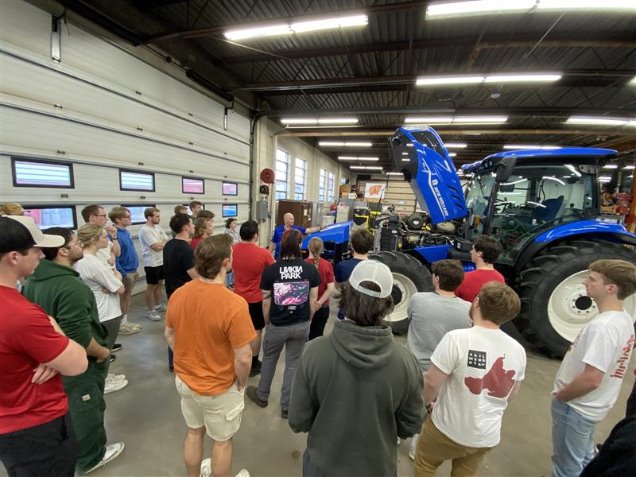
CNH donated a New Holland methane-powered tractor to UW–Madison, giving students and researchers direct access to clean-energy equipment with applications in agriculture, alternative energy, and sustainable operations.
Quick Facts
CNH
North American headquarters: Oak Brook, Illinois
Industry: Agriculture and construction equipment
Wisconsin presence: Case IH Racine Plant and Racine Experience Center in Sturtevant, Wisconsin
Wisconsin employees: 1,900

The tractor supports educational programming across the College of Agricultural and Life Sciences and the College of Engineering, including CALS’ Agricultural Research Station Network. Designed to run on methane, it offers a cleaner-energy option for operations that need reliable horsepower without the scale of larger field equipment.
“This gift reflects what is possible when industry and UW–Madison work together around shared goals,” said Troy Runge, CALS associate dean for research. “The tractor will support teaching and research while helping students better understand the practical challenges and opportunities facing agriculture, energy, and sustainability.”
“This gift reflects what is possible when industry and UW–Madison work together around shared goals.”
Impact and results
The donation helps connect classroom learning with real industry needs. Students are gaining hands-on exposure to emerging agricultural technology and alternative-fuel systems they may encounter in future careers. Researchers are gaining a platform for studying biogas end uses, energy integration, and practical applications for producers.
“For students, there is real value in working directly with current equipment and emerging technology,” said Matt Digman, an associate professor in the Department of Biological Systems Engineering in CALS. “This tractor gives us a platform for hands-on learning, testing, and discussion around how alternative-fuel systems can be used in agricultural and off-road applications.”
The tractor is also supporting research led by Dr. Becky Larson, professor and Extension specialist at the Nelson Institute for Environmental Studies.
“This equipment allows us to explore alternative biogas end uses to provide producers with real operational data to evaluate their energy integration options,” said Dr. Becky Larson. “It supports research that can help farmers invest in technology that is productive, cost-effective, and environmentally responsible.”
For CNH, the partnership creates a direct connection to UW–Madison students, faculty, and research programs while supporting the next generation of engineers and agricultural professionals.
“This equipment… supports research that can help farmers invest in technology that is productive, cost-effective, and environmentally responsible.”
Looking ahead
The tractor donation is part of a broader relationship between CNH and UW–Madison that includes research collaboration, student projects, scholarships, professional development, and community impact. CNH recently approved a first-time $10,000 grant to support scholarships for students in CALS and the College of Engineering.
“Through our CNH University Partnerships, we are giving the next generation of ag workers and leaders a firsthand look at the New Holland T6 Methane-powered tractor as an alternative fuel option,” said Sean Dorosz, medium tractor product marketing manager at CNH. “The collaboration reflects a broader, continuous effort by CNH to work closely with universities to advance innovation and prepare the next generation of engineers and agricultural professionals.”
Through partnerships like this, UW–Madison and industry partners can create hands-on learning opportunities, support applied research, and build practical solutions for Wisconsin agriculture, energy, and communities.