Research collaboration with American Family Insurance highlights UW’s ability to tackle business challenges.
“Big data” and “analytics” have overturned fields ranging from astrophysics to online retail. Now, American Family Insurance, a major multi-line insurer with 4,800 employees in Wisconsin, is seeing results from a formal research collaborative with the University of Wisconsin–Madison to apply big data analytics to the company’s datastream.
 “We want to use data to create new opportunities across the business, including service and pricing, to bring additional value to customers,” says Justin Cruz, vice-president of strategic data and analytics at American Family.
The collaboration draws on graduate students and professors from the Wisconsin School of Business, the Department of Computer Science, the Department of Electrical and Computer Engineering, the Department of Statistics, and other units with expertise in data science.
Data within the insurance industry offers plenty of opportunities, says Cruz. “One fundamental requirement when you write a policy is to understand the risk, and there’s always a maze of factors that affect risk.” For an auto policy, to determine how likely the applicant is to have a claim, the insurer looks at factors such as driving record, age, region and type of car. Better ability to explore the “granular” data in the company’s files should lead to more precise measurements of risk, and therefore more accurate pricing.
Projects at UW–Madison with American Family funding include:
“We want to use data to create new opportunities across the business, including service and pricing, to bring additional value to customers,” says Justin Cruz, vice-president of strategic data and analytics at American Family.
The collaboration draws on graduate students and professors from the Wisconsin School of Business, the Department of Computer Science, the Department of Electrical and Computer Engineering, the Department of Statistics, and other units with expertise in data science.
Data within the insurance industry offers plenty of opportunities, says Cruz. “One fundamental requirement when you write a policy is to understand the risk, and there’s always a maze of factors that affect risk.” For an auto policy, to determine how likely the applicant is to have a claim, the insurer looks at factors such as driving record, age, region and type of car. Better ability to explore the “granular” data in the company’s files should lead to more precise measurements of risk, and therefore more accurate pricing.
Projects at UW–Madison with American Family funding include:
 Closer alignment with UW–Madison also helps create a “really awesome place to work,” Cruz says. “If you come here, you are going sit to down with a UW–Madison Ph.D. student or a post-doc to do cutting edge data science research, and you may get your name listed on the publication.”
The campus’s impact is already deep at American Family, where chief research scientist Glenn Fung, a UW–Madison graduate with a Ph.D. in computer science, leads the insurer’s side of the collaboration. This enhanced interaction “is a huge attraction for top-tier data scientists working with us who may have a master’s or Ph.D., and don’t want to give up publishing, says Cruz. “Now our employees can have the best of both worlds: earn a corporate salary, and have greater visibility and better job prospects if they decide to move on.”
The research collaborative benefits both company and campus because there are real-world problems to solve, says Melissa Simon, a university business liaison with the Office of Business Engagement (formerly the Office of Corporate Relations), which facilitates business partnerships with diverse campus resources.
The collaborative’s steering committee, Simon says, “is charged with trying to figure out what this open dialogue means for UW–Madison and American Family. We take a holistic view of their business challenges and look for solutions throughout our campus.”
The potential benefits include internships, class projects and professional development for staff at American Family.
With its wealth of data, the insurance industry offers “a real opening for data science,” Cruz says. “Now that we are capturing a lot of data, we want to understand what it means. Especially in artificial intelligence, some of the most powerful transformative tools are getting built in academia. Now we have the capability to work together to make something even better.
“Some say insurance is the original data business, and there is definitely some truth to that,” Cruz concludes. “But until recently, we have not been able to make full use of the data we have. The technology improvements we are funding at UW–Madison are changing that, and both sides are benefiting.”
David Tenenbaum | University Communications
Closer alignment with UW–Madison also helps create a “really awesome place to work,” Cruz says. “If you come here, you are going sit to down with a UW–Madison Ph.D. student or a post-doc to do cutting edge data science research, and you may get your name listed on the publication.”
The campus’s impact is already deep at American Family, where chief research scientist Glenn Fung, a UW–Madison graduate with a Ph.D. in computer science, leads the insurer’s side of the collaboration. This enhanced interaction “is a huge attraction for top-tier data scientists working with us who may have a master’s or Ph.D., and don’t want to give up publishing, says Cruz. “Now our employees can have the best of both worlds: earn a corporate salary, and have greater visibility and better job prospects if they decide to move on.”
The research collaborative benefits both company and campus because there are real-world problems to solve, says Melissa Simon, a university business liaison with the Office of Business Engagement (formerly the Office of Corporate Relations), which facilitates business partnerships with diverse campus resources.
The collaborative’s steering committee, Simon says, “is charged with trying to figure out what this open dialogue means for UW–Madison and American Family. We take a holistic view of their business challenges and look for solutions throughout our campus.”
The potential benefits include internships, class projects and professional development for staff at American Family.
With its wealth of data, the insurance industry offers “a real opening for data science,” Cruz says. “Now that we are capturing a lot of data, we want to understand what it means. Especially in artificial intelligence, some of the most powerful transformative tools are getting built in academia. Now we have the capability to work together to make something even better.
“Some say insurance is the original data business, and there is definitely some truth to that,” Cruz concludes. “But until recently, we have not been able to make full use of the data we have. The technology improvements we are funding at UW–Madison are changing that, and both sides are benefiting.”
David Tenenbaum | University Communications
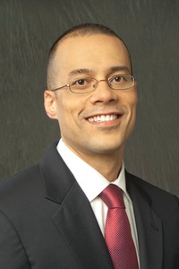
Justin Cruz, VP Strategic Data & Analytics, American Family Insurance
-
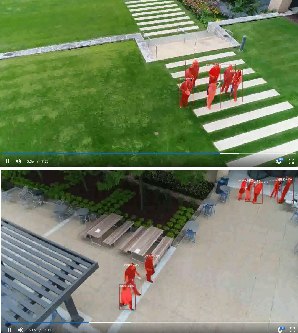
Drone images – As the company ponders expanded use of drones to assess storm damage, its wants to defocus faces in photos to prevent invasion of privacy. The partnership includes computer science professor Vikas Singh.
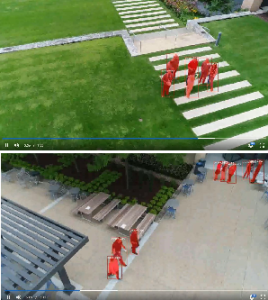
A system developed by researchers at UW–Madison and American Family automatically blurs the image of people photographed while property losses are being documented.
- Time patterns: Data on work flow can streamline operations and ensure customer satisfaction, Cruz says. “Before we cut a check to settle a claim, there can be many steps, including phone calls, visits to the claim center and decisions by the adjustor.” With a smarter analysis of work flow, “We can predict customer satisfaction and quickly correct obstacles.” Business professor Neeraj Arora assisted with these efforts.
- Matching: American Family wants to recognize customers across all systems to ensure they receive appropriate discounts or services. “Data can be noisy,” Cruz says. “Names are misspelled, memories fade and addresses change, so making these matches can be difficult and costly.” Working with AnHai Doan, a professor of computer science, and his grad students, “we have built and deployed a machine-learning algorithm all across our businesses that has already saved us significant money.”
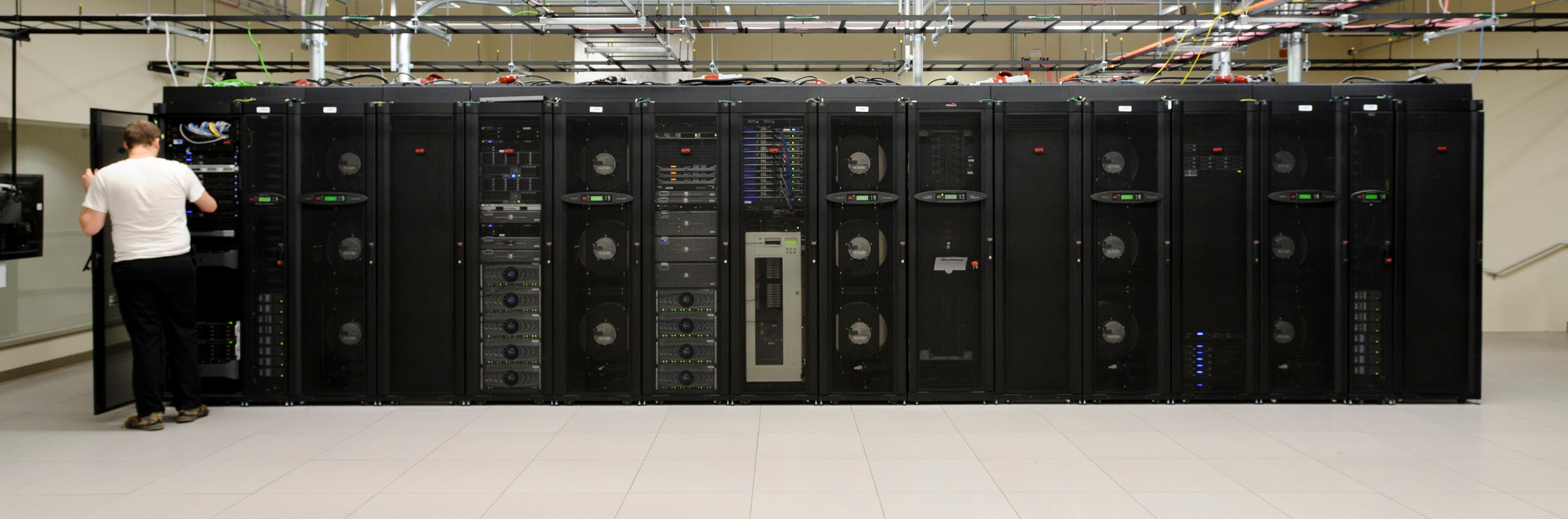
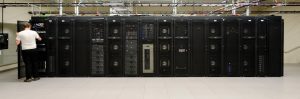
Data is the coin of the realm in academia, and increasingly, in business. These servers support UW–Madison’s Wisconsin Institutes for Discovery. Photo Jeff Miller/UW–Madison