How to turn plastic waste into a building block of Wisconsin’s economy
One word: plastics. Two words: Industry partnerships.
George W. Huber is the Richard L. Antoine Professor in UW–Madison’s Department of Chemical and Biological Engineering and a co-founder of startup companies Annellotech and Pyran. He is also the executive director of the Center for Chemical Upcycling of Waste Plastics (CUWP) at UW–Madison. While participating in an expert panel on the state of industry partnerships with the university, he shared some details of how he works with the plastic packaging industry and his experience starting up Pyran in Madison. (His remarks have been lightly edited for clarity.)Flexible Packaging
Professor Huber says, “In Wisconsin, the packaging industry employs 43,000 people. 25,000 of them are employed in the flexible packaging industry. Plastic resins are produced in Texas and shipped via rail to Wisconsin where we use all sorts of technology to make the fancy package that goes in your store. Amcor, the world’s largest packaging producer, makes some of this flexible packaging. Their US headquarters is in Neenah, Wisconsin. Flexible food packaging continues to gain a lot of market share due to its low cost and light weight. Other advantages [to flexible packaging] include your food lasts longer, you can microwave it, you can open it and close it. But there are disadvantages. The main disadvantage is you can’t recycle flexible packages today. The production process also generates lots of waste.Industry can’t focus on this right now—their profit structure doesn’t allow them to do that—but we can at the university.“We have developed the technology that uses solvents to recycle the flexible packaging material and have demonstrated it in the laboratory. Amcor and other companies (our center works with 23 different companies) have sent us their waste material, and we’ve sent them back the virgin resins. Amcor has told us, ‘The quality of what you’re making is very good—can you give us 10 tons of it?’ We can’t make 10 tons of it. In the laboratory, we’re trying to make one kilogram of it. It’s taken my graduate student four months to do that. “We’ve designed a pilot system to scale it up that can produce 25 kilograms an hour that we want to commercialize. We have a location in Green Bay where we will use our technology to take waste from Amcor and other plastic processors, to produce 500 kilograms per hour of pure resins, and send them back to the plastic converters. This closed loop recycling business makes business sense. We now need to demonstrate the technology and bring it to the market. “Our goal is to get this commercial facility built in 2026 or 2027, so we’re three to five years out. Companies can’t do research that’s five or more years out because they’re looking quarter to quarter. Industry can’t focus on this right now—their profit structure doesn’t allow them to do that—but we can at the university.”
Benefits of Partnering with UW–Madison
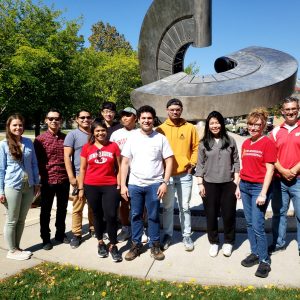
Dr. George W. Huber’s research group in the Department of Chemical and Biological Engineering at the College of Engineering at UW–Madison, as of September 2021. (courtesy George W. Huber)
When we’re trying to pioneer a process nobody has done before, we face lots of technical challenges. Luckily, we can always go to someone [who] can provide us with expertise.“The university protected the IP—WARF is very good at that. We went through the WARF accelerator program that gave us some initial funding for technology demonstration. My graduate student stayed on with my lab a year, and I said ‘your job is to make samples; we’re going to form a business plan and start turning this into a business.’ He did a fabulous job with that; now he’s the CTO of Pyran, Kevin Barnett.”